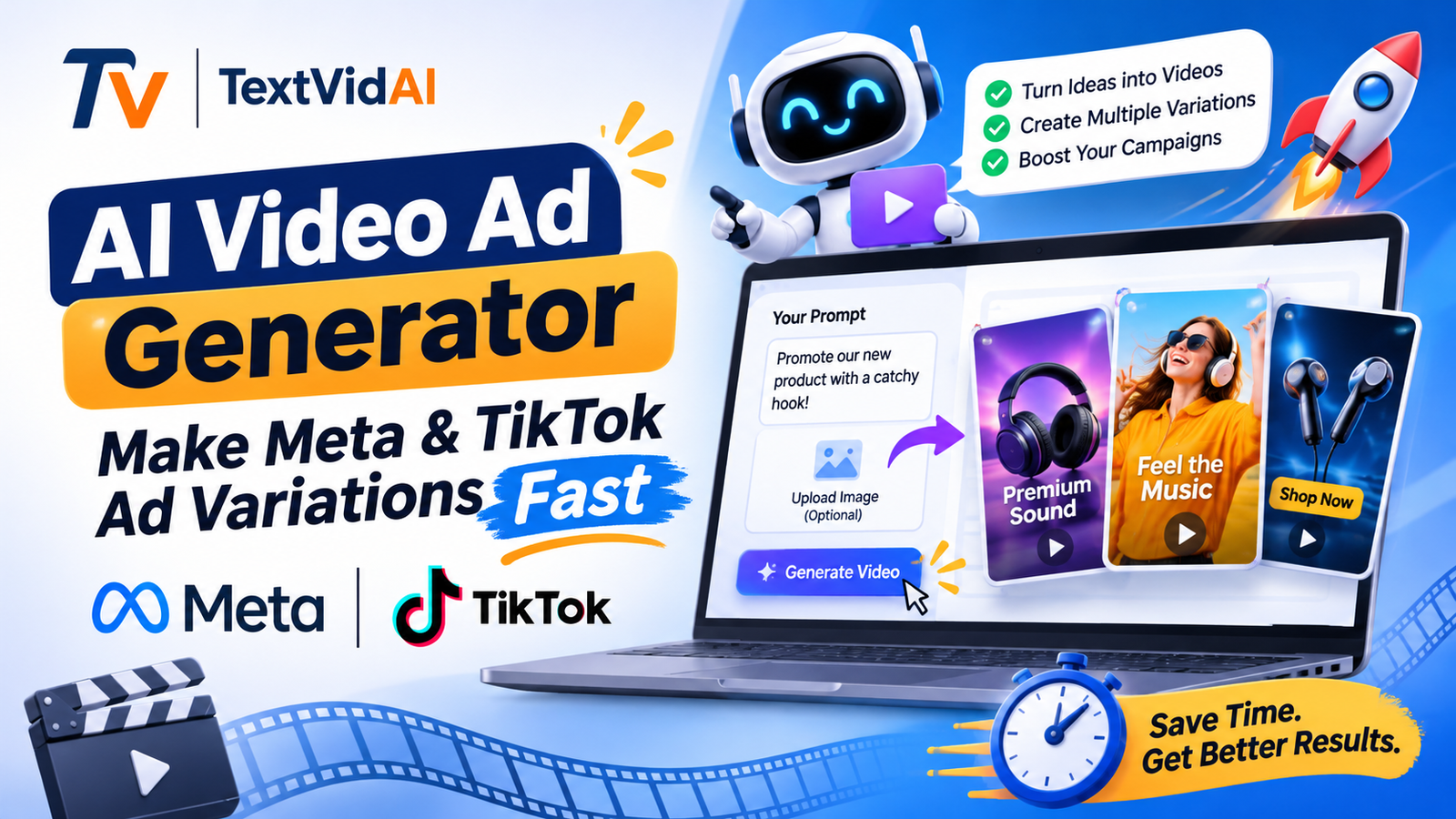
Creating successful social media advertisements requires more than an attractive product image and a catchy headline. Businesses need engaging videos, strong opening hooks, clear messages, and creative variations that connect with different audiences. However, producing multiple video ads manually can take considerable time, especially when marketers are managing campaigns across Facebook, Instagram, and TikTok.
This is where an AI Video Ad Generator becomes useful. It helps marketers transform written ideas, product images, and creative concepts into video content without going through a complicated production process. Instead of spending hours creating every version from scratch, businesses can experiment with different visuals, messaging, and storytelling approaches more efficiently.
With tools like TextVidAI, marketers can turn text prompts, images, and audio into AI-generated videos. This makes it easier to develop fresh advertising concepts and prepare creative assets for different social media campaigns.
What Is an AI Video Ad Generator?
An AI video ad generator is a tool that uses artificial intelligence to create video content from written prompts, images, or other inputs. It simplifies video production by automating parts of the creative process that traditionally require editing software, technical knowledge, and significant production time.
For example, an ecommerce business promoting a new skincare product can describe its advertising concept, provide a product image, and generate a video showing the product in an attractive setting.
Similarly, a digital marketing agency can develop different video concepts for a client's campaign without producing every creative asset manually.
Modern AI video tools offer several capabilities, including:
Text-to-video generation from written descriptions.
Image-to-video animation for existing product photographs.
AI-generated cinematic scenes and visual effects.
Different creative styles and video concepts.
Video generation through multiple AI models.
HD and 4K video output, depending on the tool and plan.
These capabilities make AI video creation a practical option for marketers who need fresh advertising content regularly.
Why Businesses Need Multiple Meta and TikTok Ad Variations
Running one advertisement repeatedly may limit opportunities to discover which creative approach connects with potential customers. Different people respond to different messages, visuals, and advertising styles.
For instance, someone shopping for wireless headphones might respond to a video highlighting sound quality, while another customer may be more interested in battery life or affordability.
Creating multiple ad variations allows businesses to explore these different interests.
Here are some reasons why creative variations matter:
1. Reach Different Audience Interests
Different advertising messages can appeal to different customer segments. One video might focus on product benefits, while another highlights customer problems and practical solutions.
2. Reduce Creative Fatigue
When audiences repeatedly see the same advertisement, they may gradually lose interest. Introducing fresh visuals, hooks, and storytelling approaches helps keep campaigns relevant.
3. Discover Better Advertising Messages
Testing different video concepts helps marketers understand which messages generate stronger engagement, clicks, and conversions.
4. Improve Creative Production Speed
Instead of producing every video manually, marketers can use AI tools to explore multiple concepts and develop additional creative assets more efficiently.
How an AI Video Ad Generator Helps Create Ads Faster
Traditional video production often involves scripting, recording, editing, selecting footage, adding transitions, and exporting the final video. Even a relatively simple advertisement can require several production steps.
An AI-powered workflow reduces much of this manual effort.
1. Turn Written Prompts Into Video Ads
The process starts with a creative idea. Marketers can describe the product, target audience, visual style, and desired scene in a written prompt.
For example, a fitness brand could use a prompt describing an athlete exercising in a modern gym, highlighting the product's performance benefits.
The AI system interprets the description and generates a video based on the selected creative direction.
2. Transform Product Images Into Engaging Videos
Product photography is an important part of ecommerce advertising, but static images do not always communicate a product's full appeal.
Image-to-video technology can add movement to existing photographs and transform them into more dynamic visual content.
A clothing retailer, for example, could animate product photography to create promotional visuals for Instagram Reels or TikTok campaigns.
3. Experiment With Different Creative Concepts
One of the biggest advantages of AI video creation is the ability to experiment.
Marketers can generate several versions of an advertisement by changing the background, camera movement, visual style, product presentation, or opening concept.
For example, a coffee brand could create:
A lifestyle-focused video showing someone enjoying morning coffee.
A product-focused advertisement highlighting packaging and quality.
A promotional video featuring a special discount.
A cinematic video showing coffee preparation.
Each variation communicates a different message while promoting the same product.
How to Create Meta and TikTok Ad Variations Using TextVidAI
TextVidAI provides an AI-powered video creation platform that brings multiple video generation models together. It supports text, image, and audio inputs, allowing users to explore different approaches to video production.
Its workflow is straightforward.
Step 1: Prepare Your Advertising Idea
Start by identifying the product or service you want to promote. Decide what message the advertisement should communicate and what action you want viewers to take.
A clear creative brief makes it easier to generate relevant results.
Step 2: Enter a Text Prompt or Upload an Image
Visit the TextVidAI video generator and provide your creative input.
You can describe the scene through text, upload an existing image, or use an audio input to develop your video concept.
For example, an online store could upload a product photograph and describe the desired promotional setting.
Step 3: Generate Your Video
TextVidAI brings together more than 50 AI models, including Sora 2, Veo 3.1, Kling 2.6, and Wan 2.6.
According to its website, the platform automatically selects a suitable model for the creative style. This simplifies the process for users who do not want to manage different AI tools individually.
Step 4: Create Additional Variations
After generating the first video, develop alternative prompts to explore different advertising approaches.
Keep the product and primary offer consistent while experimenting with different hooks, visual styles, and storytelling concepts.
This creates opportunities to test which creative direction resonates with your audience.
Step 5: Download and Prepare Your Videos
Once the video is ready, download it and review the final result.
TextVidAI supports HD and 4K exports, while watermark-free downloads are available on paid plans.
Before publishing, check the video dimensions, captions, branding, audio, and placement requirements for your chosen advertising platform.
Best Practices for Creating Meta and TikTok Video Ads
Generating videos is only one part of a successful advertising strategy. The creative itself must match the platform and audience.
Start With a Strong Opening Hook
The first few seconds of an advertisement are important because viewers can quickly scroll past content that does not interest them.
Start with a question, surprising visual, product demonstration, or relatable customer problem.
For example, instead of opening with a company logo, a cleaning product advertisement could begin with a difficult stain and immediately show how the product addresses it.
Use Vertical Video Formats
Vertical videos are particularly important for mobile-first placements such as TikTok, Instagram Reels, and Facebook Reels.
A 9:16 aspect ratio is a practical starting point for full-screen vertical advertising. Keep important text, product details, and branding within the platform's visible safe areas.
Focus on Benefits Rather Than Features
Customers want to understand how a product can improve their everyday lives.
Instead of simply listing product specifications, demonstrate practical benefits through visual storytelling.
For example, a laptop advertisement could show how a lightweight design makes working while travelling easier.
Add Captions and Clear Calls to Action
Some viewers watch advertisements without sound, making captions useful for communicating the main message.
Finish each video with a relevant call to action, such as Shop Now, Learn More, Explore Products, or Get Started.
TikTok also recommends using engaging hooks, sound, captions, and clear storytelling to improve creative quality.
Keep Testing Different Approaches
Do not assume that the first generated video will be the best performer.
Experiment with different openings, visuals, messages, and calls to action. Review campaign metrics to identify which versions deserve more attention.
How to Measure the Performance of AI-Generated Video Ads
Creating multiple advertisements is valuable only when marketers understand how those creatives perform.
Both Meta Ads Manager and TikTok Ads Manager provide campaign performance information that can help businesses evaluate their advertising strategies.
Some important metrics include:
Click-Through Rate (CTR): Measures the percentage of impressions that result in clicks. It helps marketers understand whether their advertisements encourage viewers to take action.
Cost Per Click (CPC): Shows how much a business spends for each click generated by an advertisement.
Conversion Rate: Measures how many visitors complete a desired action, such as purchasing a product or submitting a form.
Cost Per Acquisition (CPA): Helps businesses understand the cost of acquiring a customer or generating a conversion.
Video Watch Time: Shows how long viewers engage with video content and can help identify where audiences lose interest.
By comparing these metrics across different creative variations, marketers can make more informed decisions about future campaigns.
Common Mistakes to Avoid When Using AI Video Ad Generators
Although AI tools simplify video production, marketers should avoid relying entirely on automated results.
Some common mistakes include:
Using the same creative everywhere: Different platforms have different audience expectations and content styles.
Ignoring the opening hook: A visually attractive video may still struggle if it takes too long to communicate its message.
Adding too much text: Overloaded visuals can make advertisements difficult to understand.
Skipping quality checks: Always review generated videos for visual inconsistencies, incorrect product details, and unnatural movements.
Ignoring advertising policies: Ensure that generated content, music, product claims, and disclosures follow the relevant platform requirements.
Human review remains important for maintaining brand consistency, accuracy, and customer trust.
Conclusion
Creating effective advertisements requires continuous experimentation, fresh creative concepts, and a clear understanding of audience interests. An AI Video Ad Generator makes this process more manageable by helping businesses transform text prompts, images, and audio into engaging video content.
For marketers running Meta and TikTok campaigns, AI video generation provides an opportunity to explore different advertising concepts, develop creative variations, and reduce the time involved in traditional video production.
Platforms like TextVidAI bring multiple AI video models into one place, making it easier to experiment with text-to-video and image-to-video creation.
By combining AI-powered production with thoughtful creative planning, performance tracking, and human review, businesses can build a more flexible video advertising strategy and continuously discover new ways to connect with their audiences.