Most paid social campaigns don't fail because of targeting. They fail because the creative gets tired.
You launch one video, it does well for about a week, and then your cost per click starts climbing. On TikTok it happens even faster. People scroll past an ad they've already seen, and the algorithm notices.
The fix everyone agrees on is testing more creative. The problem is that making ten versions of a video ad used to mean ten rounds of editing. That's where an AI video ad generator changes the math.
What an AI Video Ad Generator Actually Does
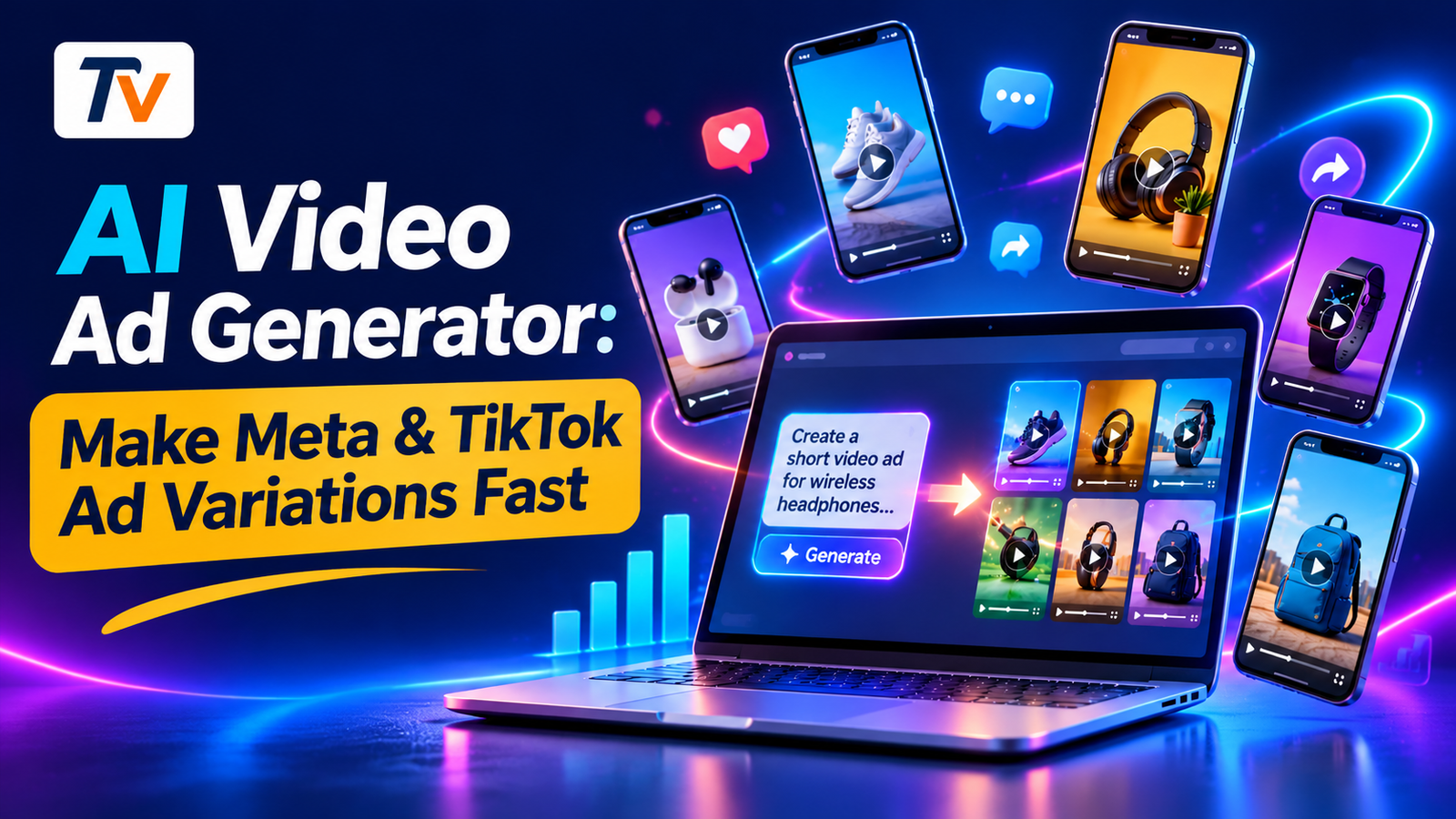
An AI video ad generator turns a script, product description, or short prompt into a finished video ad. You give it the message, and it handles the visuals, voiceover, captions, and format.
With TextVidAI, you write your idea as text and get a video back. Then you change one line, the hook, the offer, or the call to action, and generate another version. No timeline editing and no re-exporting from scratch.
That's the real value. You aren't only making one video faster. You're making twenty versions in the time one used to take.
Why Variations Matter More Than One "Perfect" Ad
Meta and TikTok both reward creative volume. Their delivery systems test your ads against real audiences and push budget toward whatever performs. If you give them one ad, they have nothing to compare it with.
A good testing setup usually changes one thing at a time:
The hook: the first two or three seconds that decide whether someone keeps watching
The angle: price, convenience, results, or social proof
The format: talking-style, product demo, or text-on-screen
The CTA: "Shop now," "Try free," or "See how it works"
Three hooks times three angles already gives you nine ads. Building that by hand takes days. With AI, it takes an afternoon.
Meta vs TikTok: What Each Platform Wants
The same ad rarely works on both platforms without changes.
Meta (Facebook and Instagram) gives you a bit more room. Clear product shots, a direct benefit, and readable captions do well, since many people watch with the sound off. Square (1:1) and vertical (4:5 or 9:16) formats both have a place.
TikTok wants content that doesn't look like an ad. Fast cuts, a strong opening line, and a native, casual feel tend to win. It's 9:16 vertical only, and the first second matters more than anything else.
A good AI tool lets you take one script and output both versions, so you aren't rebuilding the ad for every placement. You can see the supported formats on our features page.
How to Create Ad Variations Fast: A Simple Workflow
Here's a process that works for small brands and agencies alike.
1. Write one core script. Keep it short, 15 to 30 seconds. Lead with the problem, show the product as the fix, and end with one clear action.
2. Write five different hooks. Ask a question, make a bold claim, show a result, call out the audience ("Small business owners, listen up"), or start with a surprising number.
3. Generate each version. Paste each hook plus the core script into your text-to-video generator and render them one by one.
4. Export for each platform. Vertical for TikTok and Reels, 4:5 for the Meta feed.
5. Launch and let data decide. Run them together with an even budget for three to five days. Kill the losers, then make new variations of the winner.
That last step is where most teams stop. Don't. Your best ad is a starting point for the next round of tests, not the finish line.
Tips That Make AI Video Ads Perform Better
Captions are not optional. A large share of feed viewers watch muted.
Put the product on screen early. If people only see it at second twelve, most of them never will.
Keep one message per ad. Trying to say everything usually means saying nothing.
Refresh every two to three weeks. Creative fatigue is real, especially on TikTok.
Write like you talk. Stiff, corporate scripts sound worse when read aloud.
Who Gets the Most Out of This
AI video ad tools are especially useful for:
E-commerce brands testing products across several audiences
Agencies handling many clients with tight turnaround times
Solo founders who don't have a video editor or budget for one
Performance marketers who need constant creative refreshes
If you produce more than a handful of video ads a month, the time savings add up quickly. Check our pricing plans to see what fits your volume.
Common Mistakes to Avoid
Testing too many changes at once makes results useless, because you won't know what actually worked. Change one variable per ad.
Judging too early is the second trap. One day of data isn't enough. Give each ad enough spend to say something real.
The third is letting AI write everything with no edits. Use the generated draft as a base, then add your own product details and the words your customers actually use.
Frequently Asked Questions
What is an AI video ad generator?
It's a tool that creates video ads from text, scripts, or prompts, handling visuals, voiceover, and captions automatically.
Can I use AI-generated videos for Meta and TikTok ads?
Yes. Both platforms accept AI-made video creative, as long as it follows their normal ad policies.
How many ad variations should I test?
Starting with three to five variations per ad set is a practical baseline for most budgets.
Do I need video editing skills?
No. With TextVidAI, you work with text, and the tool builds the video.
Final Thoughts
Winning on Meta and TikTok today comes down to testing speed. The brands that ship more creative learn faster, and the ones that learn faster spend less to get the same results.
An AI video ad generator won't write your strategy for you. What it does is remove the slow, expensive part, so you can focus on ideas and let the data pick the winners.
Ready to make your first batch? Start creating with TextVidAI and turn one script into a full set of ad variations today.